Tactile Communication Tools for Deaf-Blind Dogs
By Liam O'Connell • 10th May
Introduction
Deaf-blind dogs live in a fundamentally different sensory landscape than their sighted, hearing peers. Yet they can learn, bond, and navigate safely when handlers understand how to communicate through touch. Tactile communication tools and deaf-blind dog training equipment bridge that gap, not through gadgetry, but through biomechanics, consistency, and field-tested design. This FAQ explores how to select, test, and deploy tactile systems that keep your dog safe, confident, and reliably responsive across the environments where your life unfolds: home, city streets, and trails.
The underlying principle mirrors what I've learned testing gear in mud and rain for years: if it fails on trail, it fails the dog. Deaf-blind communication is no different. Your tools must withstand weather, maintain tactile clarity when wet, and perform reliably over hundreds of repetitions. Adventure expands safely when recall and touch-based understanding come first.
FAQ: Tactile Communication Tools for Deaf-Blind Dogs
What Exactly Are Tactile Communication Tools?
Tactile communication tools are physical interfaces (harnesses, collars, long lines, and body-positioning techniques) that convey meaning through vibration, pressure, or directional touch. Unlike hearing or sighted dogs who respond to vocal cues or hand signals, deaf-blind dogs rely on a repertoire of distinct tactile patterns to understand "stop," "go," "come," "settle," and safety boundaries.
The foundation is pattern recognition. A dog learns that a specific vibration frequency means "recall" (come toward me). A sustained pressure on the harness at the shoulder might signal a downhill descent on a steep trail. A gentle tap on the chest could mean "settle." These are not aversive corrections; they are information delivered through the dog's most reliable sense: touch.
Field notes from handlers confirm what research on canine learning supports: deaf-blind dogs can encode tactile patterns as reliably as hearing dogs encode verbal cues, provided the patterns are:
- Distinct (each cue feels unmistakably different)
- Consistent (delivered the same way every time)
- Positive (paired with rewards, never punishment)
- Durable (reliable in mud, rain, and changing temperature)
How Does Vibration Compare to Manual Touch Cues?
Vibration-based systems (such as dog training collars with vibration) offer precision and reach. A collar fitted correctly sits in the contact zone where a dog can feel a pulse without discomfort. The advantage is range: from 20 feet away on a trail, you can signal your dog reliably without moving closer.
Manual touch cues (thumb pressure on the harness, a directional sweep along the spine) require proximity. On a busy trail or in a chaotic environment, that limits responsiveness.
However, vibration systems have failure modes:
- Battery dependency. A dead battery on a trail removes your primary communication channel.
- Weather sensitivity. Moisture in connectors, temperature fluctuations affecting circuit response, and salt spray corrosion degrade performance.
- Tactile fidelity loss. A dog may initially learn vibration well, but in high-arousal situations (wildlife encounter, another dog approaching), the signal can feel ambiguous compared to the clear, directional pressure of a handler's hand.
A hybrid approach balances precision with redundancy. Use vibration as your primary signal in open, low-distraction environments. Layer in manual touch cues during high-stakes moments (recalls near traffic, transitions at trail junctions, or settling in crowded public spaces). This dual-channel system means your dog remains responsive even if vibration equipment fails.
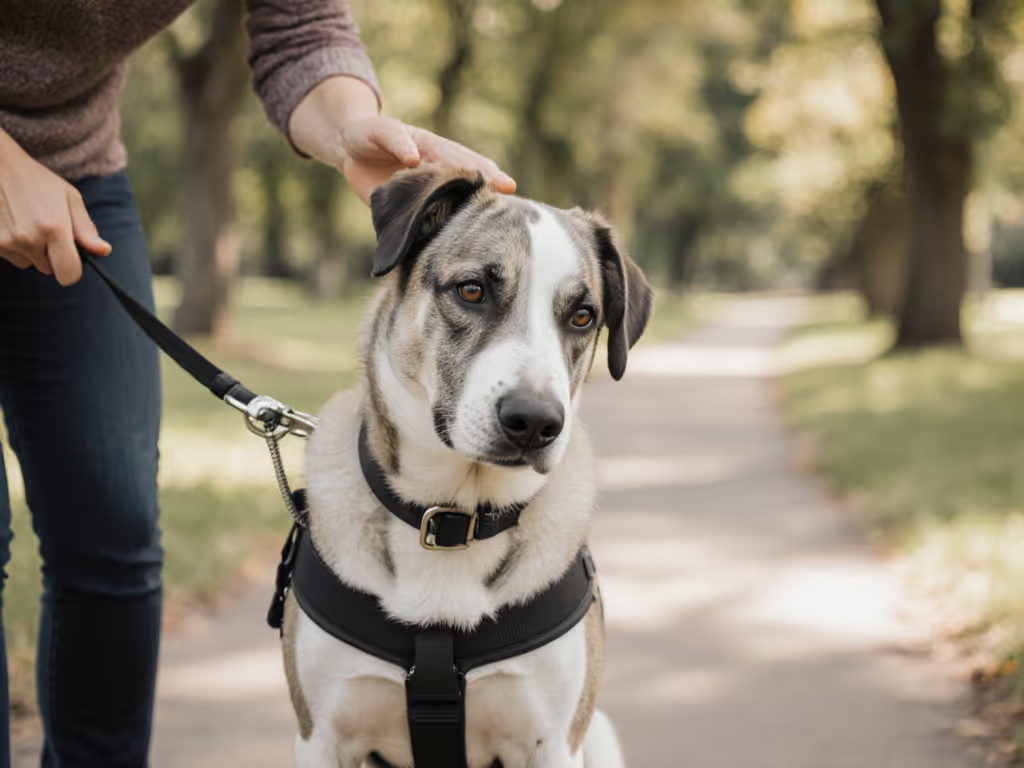
What Role Does Touch-Based Dog Training Play in Building Reliable Recall?
Recall is non-negotiable for deaf-blind dogs in any environment where wildlife, traffic, or other dogs present risk. Touch-based recall training requires a long line (typically 10-30 meters of biothane or similar material with clear tactile grip even when wet). For choosing lines, see our long line comparison.
Here's the progression:
- Home foundation (weeks 1-3): Introduce your vibration pattern or a signature touch sequence (e.g., two taps on the harness followed by a sweep toward you) while the dog is close. Reward heavily.
- Short-distance repetition (weeks 4-8): Practice at 5-10 meters with the long line. Signal, reward immediately when the dog turns toward you.
- Weather robustness testing (weeks 9-12): Practice in rain, mud, and changing light conditions. A signal that works on a dry living room floor may feel muted when the dog's coat is wet or the handler's hand is muddy. Test it wet and muddy.
- Environmental complexity (weeks 13-16): Introduce mild distractions (rustling leaves, distant movement) and practice signal clarity under increasing arousal.
Handlers often assume recall failure reflects the dog's stubbornness. More often, it reveals a communication failure: the signal was unclear, inconsistently delivered, or untested under real-world conditions.
Terrain-specific tips: On a steep downhill, pressure-based signals (a firm grip on the harness) often outperform vibration because the dog's focus is on footing, not a subtle pulse. In high-wind conditions, vibration may feel dampened; switch to exaggerated touch patterns.
What Gear Best Supports Multi-Sensory Training Aids?
For a deaf-blind dog, multi-sensory means layering tactile input with other remaining senses (proprioception, olfaction, taste through reward timing, and spatial memory of landmarks or familiar surfaces).
Effective adaptive equipment for deaf-blind dogs includes:
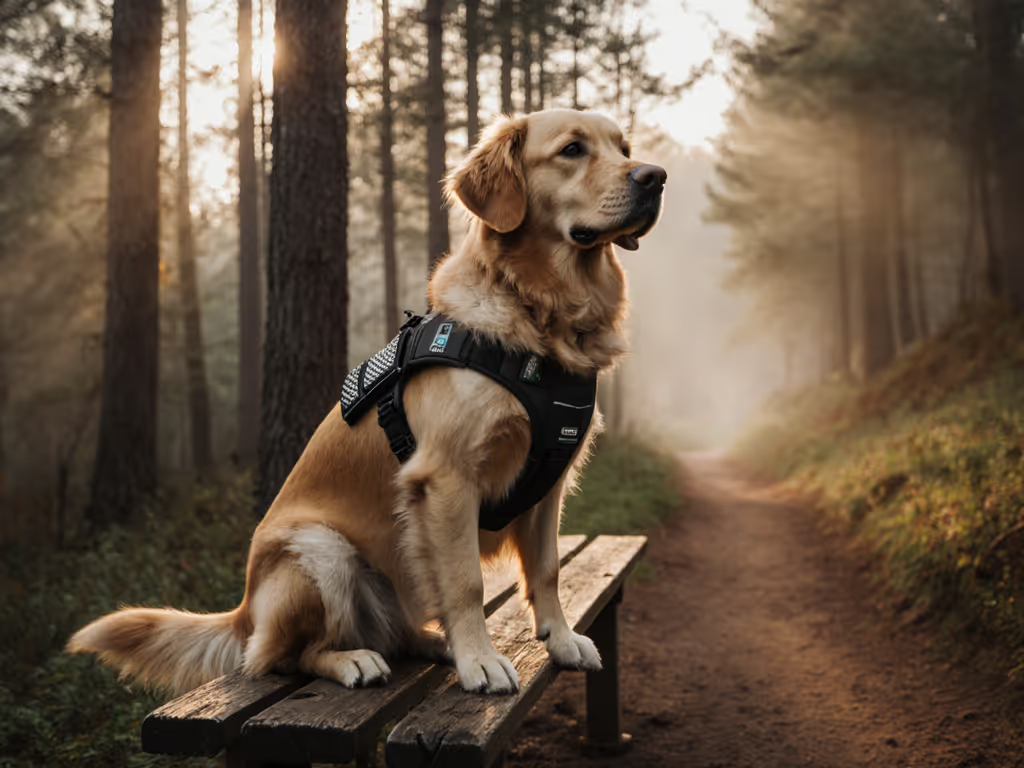
- Harnesses with clear pressure zones. A Y-harness design allows you to apply directional pressure (pull left at the shoulder to signal a left turn, downward pressure on the spine for "sit" or "settle"). A poorly designed harness diffuses pressure across the ribs, making signals ambiguous. For breed-specific clip placement and fit that preserve clear pressure signals, see front vs back-clip harness fit.
- Long lines in high-grip material. Biothane, a synthetic webbing, maintains tactile feedback in wet, muddy conditions far better than cotton. A dog on a slippery, unresponsive lead cannot feel directional cues reliably.
- Tactile collar tags or markers. Some handlers attach small, textured objects to the collar (a rubber tab, a tasseled rope) so the dog can feel the collar and associate it with communication mode.
- Scent markers at key waypoints. On a familiar trail, place a scented marker (e.g., an essential oil on a stake) at decision points. The dog associates scent with location and behavior cues; your vibration signal becomes "pay attention to scent marker" rather than an abstract instruction.
Failure-mode analysis: Harnesses that rely solely on neck pressure (like older-style slip collars) can damage the trachea and obscure clear communication. A Y-harness distributes pressure across the chest, reducing injury risk while improving signal clarity.
How Do You Measure Progress and Success?
Objective milestones replace subjective impressions. Instead of "my dog seems more responsive," track quantifiable outcomes:
- Recall latency. Time from signal to dog's directional movement toward you. Goal: under 3 seconds at 10 meters; under 5 seconds at 20 meters.
- Consistency rate. Percentage of successful recalls across 10 trials. Goal: 80%+ in low-distraction environments; 60%+ in high-distraction (e.g., near wildlife).
- Settle duration. How long the dog remains in a down-stay after a "settle" signal. Goal: 2-3 minutes indoors; 1 minute in public spaces initially, increasing over weeks.
- Leash slack percentage. On a walk, measure the proportion of the walk where the leash hangs loose (no tension). Goal: 70%+ on familiar routes.
- Weather resilience check. Repeat a known drill in light rain and again after mud. If performance drops >20%, the signal lacks durability; revise your cue delivery.
These metrics clarify whether your equipment and communication system are working, or whether you need to troubleshoot. At dusk on a busy trailhead once, my dog spotted deer across the valley (a moment where a reflective Y-harness and practiced recall signals kept both of us calm and responsive). Measurable progress isn't abstract; it's the difference between control and chaos when stakes rise.
What Are Common Failure Modes in Deaf-Blind Gear?
Vibration collar connectivity loss under moisture. Rain and sweat corrode contacts. Solution: Silicone seals on battery compartments, and waterproof testing before purchasing. If you're testing a new vibration device, simulate rain: spray it, let it sit, then test function.
Harness escape due to poor fit. A deaf-blind dog cannot be called back if the harness slips off. Measure before purchase, refit every 4-6 weeks during growth, and test escape-resistance by gently tugging the harness upward. It should not slide over the shoulders. Weather disclaimer: A dry harness fits differently than a wet one; dogs swell when cold and contract when warm. Fit your harness on the dog immediately after a rainy walk, when the coat is damp and the dog's core temperature is lower.
Lead fatigue and fraying. A biothane line that's become brittle or frayed loses tactile sensitivity. Handlers can't feel the dog's weight shifts, and the dog experiences unpredictable friction. Replace annually or after heavy use.
Inconsistent signal delivery. The handler means to tap twice but sometimes taps three times. The dog learns the first two taps are ambiguous. Video-record your practice sessions and count your cue repetitions. Our video analysis apps guide makes this easy on any phone. Consistency is a skill, not an accident.
Over-reliance on vibration without fallback touch cues. Equipment fails on the trail. If your dog has never learned manual touch signals, you're temporarily unable to communicate. Always train a parallel touch-based protocol, even if vibration is your primary system.
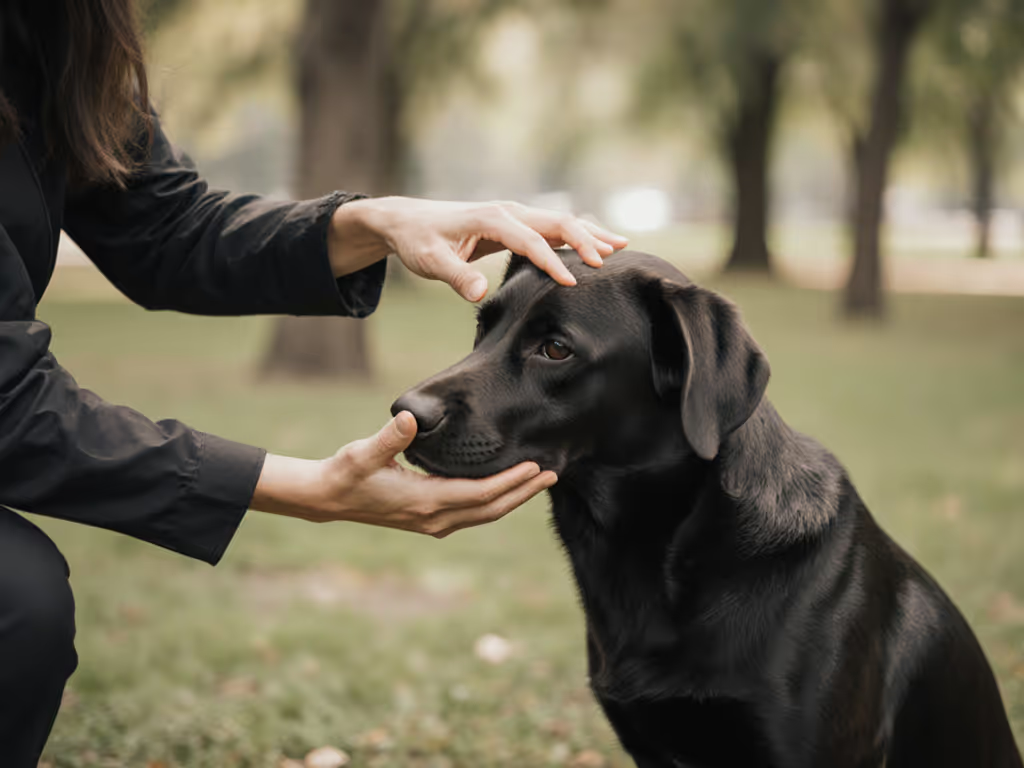
What About Weather, Trails, and Safety?
Deaf-blind dogs on trails face compounded risks: they cannot hear traffic, cannot see roots or sudden terrain drops, and cannot respond to vocal warnings from other trail users. Tactile communication becomes your only real-time feedback channel.
Field notes from trail handlers emphasize:
- Use a long line (10-20 meters). It provides constant tactile feedback (the dog's weight and movement communicate their state to you), and you can deliver directional guidance through gentle line tension. A short 2-meter lead leaves no room for safe exploration. Avoid retractable leashes—our safety analysis explains why they reduce control and increase risk for deaf-blind teams.
- Weather disclaimers: In high wind or low temperatures, vibration signals may feel muted; pivot to exaggerated touch-based cues. After rain, mud reduces foot grip; the dog's proprioception is compromised, so your tactile signals need to be clearer and more frequent.
- Visibility checks aren't about the dog seeing; they're about you seeing the dog and other trail users seeing your dog. Wear bright or reflective gear. Attach a reflective tab to the harness so other handlers can spot your team from a distance. At dusk or on overcast days, other users may not realize your dog is deaf-blind; clear visibility prevents surprises.
- Pre-scout the route. Before taking your deaf-blind dog on a new trail, walk it sighted and mark potential hazards mentally: stream crossings, steep drops, narrow bridges, high-traffic junctions.
A reliable recall under escalating terrain difficulty is your primary defense. Practice hill work, water crossings, and rocky ground during low-distraction sessions so the dog's tactile responses remain strong when real distractions appear (wildlife, other dogs, weather).
How Does Adaptive Equipment Evolve as the Dog Matures?
A puppy deaf-blind dog requires frequent refit because growth is rapid. A harness that fits at 12 weeks will compress the ribs by 16 weeks. Ill-fitting harnesses compromise tactile clarity and risk injury.
Stage-based progression:
- Puppy (8-16 weeks): Monthly refitting. Use a harness design with multiple adjustment points. Prioritize comfort and durability over advanced features.
- Adolescent (4-10 months): Growth slows; refit every 6-8 weeks. Introduce more complex terrain and distractions. A harness that felt sturdy at 12 weeks may now seem too stiff; look for designs that soften slightly with use.
- Adult (12+ months): Refit annually or after significant weight change. Upgrade harness material if needed, a puppy might tolerate softer nylon; an adult working dog benefits from biothane or reinforced webbing that withstands mud and repeated pressure cues.
Failure-mode analysis: Many handlers buy one harness and assume it fits for life. Growing dogs compress harnesses, reducing tactile sensitivity and increasing injury risk. Refit is not optional; it's part of responsible deaf-blind dog handling.
Conclusion: Testing and Integration
Tactile communication tools work reliably only when selected deliberately, fitted correctly, and tested in real conditions. The most sophisticated vibration collar fails if it doesn't fit; the best harness design offers poor communication if you haven't practiced your signal delivery.
Your next steps for deeper exploration:
- Consult a certified professional trainer experienced with multi-sensory training and tactile communication systems specific to deaf-blind dogs.
- Attend local workshops on long-line handling, tactile communication, or adaptive training if available in your region.
- Review video documentation of handlers demonstrating signal delivery, watching someone else's technique often reveals gaps in your own.
- Connect with communities of deaf-blind dog handlers who share field-tested progressions and real-world troubleshooting advice.
- Research published case studies on tactile training outcomes and failure analysis in deaf-blind canine populations.
Your deaf-blind dog has access to a rich world if you commit to clear, consistent, durable communication. The gear and techniques are proven. The variable is intentional practice and willingness to test in real conditions. That's where adaptation begins.
Related Articles