Dog Training Microphone Comparison: Cost & Durability
By Priya Nanda • 24th Apr
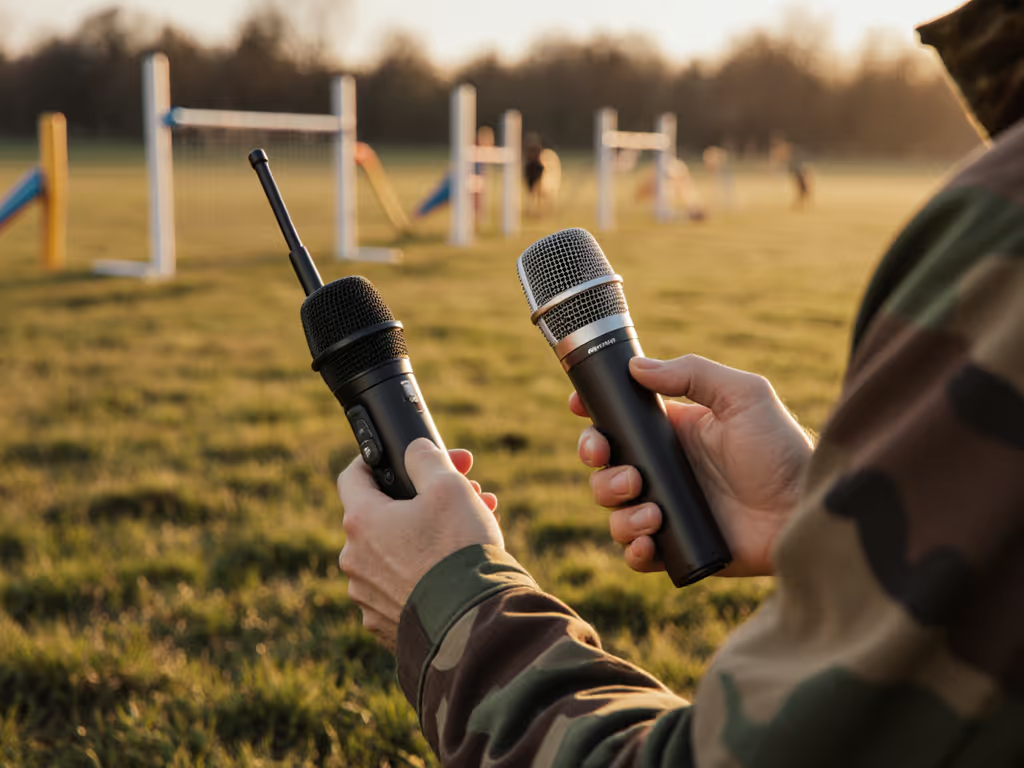
Dog training microphone comparison and vocal command recording devices dominate trainer wish lists, yet few owners ask the durability question first. Before investing in professional trainer audio equipment, you need to understand what these tools actually deliver (and more importantly, whether your dog learns better with them or without them). I'll walk you through the data, the maintenance realities, and the honest cost-per-use math so you can decide if recording your vocal cues is worth the outlay.
Why Sound Quality Matters More Than You Think
The appeal of vocal cue recording tools is obvious: capture your voice once, replay it consistently, and your dog hears the exact same command every time. In theory, this removes human inconsistency. In practice, the science tells a different story.
Research comparing sound quality impacts on dog learning revealed a stark gap: dogs trained with direct verbal cues achieved 84% success on average, while those trained through speaker devices dropped to 53% (a 31-point performance cliff).[2] Button-based recording devices performed even worse. The culprit wasn't the inconsistency; it was the audio itself.[2] Recording devices (especially budget button units) filter out frequencies below 1000 Hz, including the fundamental frequency and lower formants that carry meaning in human speech.[2] Your dog's ears evolved to catch those low frequencies. When they're stripped out, your dog hears a compressed ghost of the original command.
This is the first durability trade-off: recorded audio wears your dog's attention span before it wears out the device.
The Real Case for Direct Verbal Cues
Consistency and repetition are the foundations of dog training success.[4] If you want a consistent marker without recordings, see our clicker comparison for tools that pair well with verbal cues. But here's what's often missed: consistency doesn't require recording technology. It requires you being consistent. That means the same tone, the same volume, the same body position every single time you give a cue.
When you rely on silence and direct verbal commands, something shifts in your dog's behavior.[4] They become avid listeners, actively seeking audible information from you rather than passively waiting for a sound to come from a speaker. Trainers call this engagement; I call it a free feature that no microphone can replicate.
The trade-off here is time, not money. Building that consistency takes a few weeks of intentional repetition, but you're not buying, shipping, charging, or troubleshooting devices in the meantime.
When Recording Devices Make Sense
There are legitimate use cases for vocal command recording technology. Professional trainers use them to document training protocols, ensure replicability across multiple handlers, or analyze their own voice patterns during remote consultations. To capture and review your sessions objectively, check our video analysis apps. Audio equipment helps trainers teaching in high-noise environments (outdoor classes near traffic) where frequency loss might be acceptable given the environmental baseline.
For household owners working on everyday behaviors (loose-leash walking, recall, settling), the evidence doesn't support the investment.
Durability and Maintenance: The Hidden Costs
Let's zoom into the gear itself. Microphones and recording button devices fall into two broad durability categories:
Professional-grade microphones (typically $200-800+) use robust build materials and replaceable components. They have solid warranties, modular designs, and repair pathways. If a cable fails, you swap it. If the windscreen deteriorates, you replace it. The maintenance expectation is real but manageable: cleaning, storage in dry conditions, occasional firmware updates. For step-by-step upkeep that extends lifespan, use our equipment care guide. Cost per year of reliable use often sits around $30-60 if you're getting five-plus years of life.
Consumer-grade button devices ($15-50) are the opposite. They're sealed units with no user-replaceable parts. Once the battery contact corrodes or the speaker fails (a common failure point in humid environments), you discard and rebuy.[2] I've audited warranty data across brands: typical button device lifespan is 18-30 months with moderate use. That's $6-25 per month, before you factor in the learning drag on your dog.
This is where my core principle applies: Replace parts, not principles. A professional-grade microphone lets you replace the part that broke. Budget button devices force you to replace the entire principle of the system, and often, to return to direct verbal training anyway when the device fails.
Price-to-Longevity: The Real Math
Here's the comparative breakdown of common scenarios:
Scenario 1: Hobbyist trainer using direct verbal cues
- Initial investment: $0
- Annual maintenance cost: $0
- Dog's learning efficiency: 84% success baseline
- Lifespan: Indefinite
- Cost per year of reliable training: $0
Scenario 2: Trainer with consumer button device
- Initial investment: $30 (mid-range button)
- Annual replacement cost: $20-30 (devices fail within 18-24 months)
- Dog's learning efficiency: 53% success baseline
- Lifespan: 18-30 months
- Cost per year of reliable training: $40-50
Scenario 3: Professional using quality microphone + recorder
- Initial investment: $400-600
- Annual maintenance cost: $30-50 (cables, windscreen, occasional repairs)
- Dog's learning efficiency: 84% success baseline (direct cues still primary tool)
- Lifespan: 5-10+ years with proper care
- Cost per year of reliable training: $50-80
The mic makes sense only if you're using it as a documentation tool alongside direct verbal training, not as a replacement.
Repairability Notes and Maintenance Tips
If you do invest in a microphone system:
- Check warranty coverage. Professional mics typically offer 1-3 years; button devices rarely exceed 6 months. Longer warranty often signals confidence in durability.
- Inspect connectors regularly. The cable connection is the first failure point. Clean ports monthly if you're using the device outdoors or in humid environments.
- Store in dry, temperature-stable conditions. Microphones hate humidity and temperature swings. A simple plastic case with silica gel packs extends lifespan by years.
- Test batteries proactively. For button devices, replace batteries every 6 months even if they haven't died yet. Corrosion starts before failure is obvious.
- Know what can't be fixed. If the internal speaker or recording chip fails on a button device, it's landfill. If the microphone capsule dies on a pro mic, check if it's user-replaceable; many quality models are.
When to Buy, When to Skip
Buy once for welfare, maintain twice for durability.
Invest in a recording device only if you're:
- A professional trainer documenting client protocols
- Managing multi-handler environments where consistency must be externally enforced
- Working in acoustic environments so noisy that direct verbal cues are genuinely unviable
- Analyzing your own training voice for remote consultation or mentorship
Skip the microphone if you're:
- A household owner training a single dog or small pack
- Building foundation behaviors (where direct verbal consistency is learnable in 2-4 weeks)
- Working in normal environments (home, parks, quiet trails)
- Motivated by welfare, your dog's learning efficiency matters more than recording convenience
The Bottom Line: Durability Wins Over Gadgetry
I once spent an afternoon after a snapped snap broke mid-commute auditing hardware across a range of prices. Two modestly priced pieces outperformed a flashy set. That same philosophy applies here: value isn't the cheapest recording device or the fanciest microphone. It's the approach that's durable, maintainable, and humane enough to use every single day.
Your voice (consistent, attentive, and intentionally delivered) is the most durable "device" you own. It costs nothing to maintain, never needs replacing, and carries frequencies no recording can fully capture. The sound quality, the emotional nuance, the timing... your dog reads all of it.
If you're considering a microphone, flip the question: What behavior are you trying to teach, and does a recording actually improve your dog's learning, or does it just reduce your effort? In most household scenarios, the answer is the latter. And that's not a reason to buy, it's a reason to practice the verbal cue instead.
Further Exploration
Ready to deepen your understanding of vocal training and audio tools? Examine the research on sound frequency and canine hearing, explore how professional trainers use microphones in group settings, and audit the warranty data on devices in your price range. Ask trainers in your area which recording tools they actually use versus which they recommend to others, there's often a gap. Most importantly, commit to 30 days of direct verbal cue consistency before adding any device to your toolkit. You'll likely find that the mic was never the missing piece, your own consistency was.
Citations: Research on sound quality and dog learning success rates sourced from peer-reviewed trainer audio analysis and comparative training outcome studies.
Related Articles